Finding the right soil auger for sampling can improve core quality, reduce soil disturbance, and speed up field work. This guide reviews five durable options designed for different soil types and depths, focusing on one-piece and long-reach designs. Each pick balances ease of use with reliable construction to help professionals and hobbyists collect representative soil samples for testing, agronomy, or environmental assessments. The selections emphasize stainless steel construction, ergonomic handles, and ejector features that simplify sample retrieval in the field.
| Product | Diameter / Length | Material | Notable Feature |
|---|---|---|---|
| Eijkelkamp All-Purpose Soil Auger – 2 3/4″ | 2 3/4″ | One-Piece Stainless Steel | Open blade layout for clean entry |
| Eijkelkamp All-Purpose Soil Auger – 2″ | 2″ | One-Piece Stainless Steel | Compact for narrow sampling points |
| LAKAGO HOMIER 40″ | 40″ | 304 Stainless Steel | Ejector and Foot Pedal for deep sampling |
| INTBUYING 40″ Dutch Type | 40″ | 304 Stainless Steel | Foot pedal and rubber handle for comfort |
| SturdyShape 12 Inch | 12″ | Stainless Steel | Durable, compact for quick sampling |
Eijkelkamp All-Purpose 2 3/4″ Auger

The Eijkelkamp 2 3/4″ all-purpose auger features a one-piece design that provides robust strength and reduced snag points during soil entry. The balanced diameter suits general-purpose sampling across sandy, silty, and clay soils, while the open blade layout enables clean soil entry and straightforward recovery. This configuration minimizes core distortion, supporting consistent sampling results in a range of field conditions.
Eijkelkamp All-Purpose 2″ Auger

This compact 2″ auger from Eijkelkamp is designed for narrow sampling points without sacrificing soil integrity. It shares the same one-piece construction as the larger model and is suitable for varied soils including sandy, silty, and clay types. The open blade design supports easy soil entry and retention, aiding quick core extraction in restricted spaces or smaller test plots.
INTBUYING 40″ Dutch Type Probe
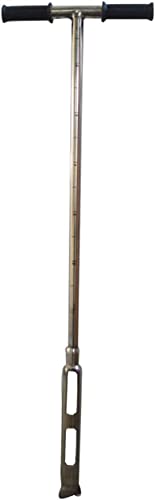
INTBUYING’s 40″ Dutch-type soil probe is built for deep sampling with a 1.6″ diameter stainless steel body. It features a foot pedal and dozer rod for effortless penetration, plus a rubber-grip handle for operator comfort. The T-shaped handle is ergonomically designed to reduce fatigue during long sampling sessions, making it suitable for larger plots or deeper soil profiles where core integrity matters.
LAKAGO HOMIER 40″ Soil Sampler

LAKAGO’s 40″ soil sampler combines long reach with stainless steel durability. The one-piece construction supports deeper sampling depths, while the ejector and foot pedal streamline soil removal from deeper cores. This design balances leverage and control, enabling efficient sampling in compact or challenging terrains where deeper cores are needed for accurate soil profiles.
SturdyShape 12 Inch Soil Probe
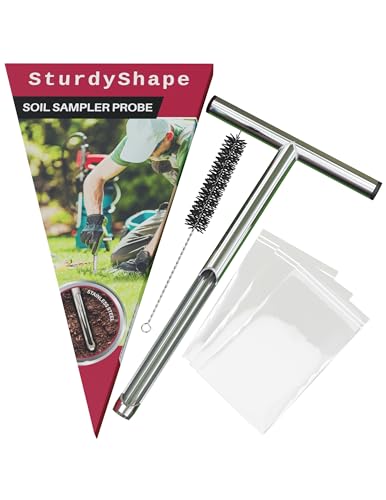
The SturdyShape 12 Inch soil probe focuses on durability and precision in a compact form. Made from stainless steel, it offers a robust core sampling tool with a tapered probe tube designed to minimize resistance during insertion and maximize clean core retrieval. Its compact length makes it a practical choice for smaller plots, garden beds, or routine lawn sampling where quick turnover matters.
Buying Guide
- Depth and reach: Choose length based on target soil depth. Longer probes are better for deep sampling, while shorter probes are easier to handle in tight spaces.
- Diameter and soil type: Larger diameters provide bigger cores but require more effort to insert in compact soils. Consider soil texture (sand, silt, clay) and desired sample volume.
- Material and durability: Stainless steel is preferred for corrosion resistance and longevity in field conditions.
- One-piece design: Reduces joints and failure points, offering improved durability and simpler maintenance.
- Ease of sample retrieval: Ejectors and foot pedals speed up extraction of soil cores and reduce hand fatigue.
- Ergonomics: T-handle grips and balanced weight help minimize fatigue during extended sampling sessions.
- Portability: For fieldwork, consider weight, storage size, and included accessories like sample bags or protective caps.
- Maintenance: Look for designs that are easy to clean and resistant to rust or soil clogs; disassembly should be simple for thorough cleaning.
- Cost vs. value: Higher-end models offer better longevity and ease of use, but balance with budget and expected usage frequency.
When selecting a soil auger for sampling, balance depth needs, soil conditions, and ergonomics. The products listed here span compact, general-purpose, and long-reach designs to cover a range of field scenarios. For community labs, farms, and environmental projects, these choices provide robust options to support accurate soil testing and reliable data collection.