This guide helps you choose a reliable water pesticide test kit for testing glyphosate and other contaminants in drinking water, ponds, wells, and more. It highlights options for different buyers—homemakers needing quick glyphosate checks, DIY testers seeking comprehensive panels, and families wanting easy at-home testing. Below, you’ll find five carefully selected products with clear pros, best-use cases, and practical cautions. A summary table compares key points to aid quick decisions.
| Product | Best For | What It Tests | Notes |
|---|---|---|---|
| Safe Home Glyphosate Test Kit | Homeowners worried about glyphosate exposure | Glyphosate up to 200 PPB | Fast five-minute result; DIY option |
| LabTech LT5015 H2O OK Plus | Comprehensive water analysis | Chlorine, hardness, iron, pH, alkalinity, copper, lead, nitrates, pesticides, and more | Includes pesticides test; bilingual instructions |
| Varify 17in1 Drinking Water Test Kit | Well and city water testers needing breadth | 17 parameters including lead, chlorine, fluoride, iron, bacteria | Color-coded strips for quick readings |
| All-New 20 in 1 Drinking Water Kit | Efficient home testing with many parameters | 20 tests; general water quality indicators | Clear results guide on bottle |
| 21-in-1 Home Drinking Water Test Kit | Families wanting broad coverage | 21 parameters; includes bacteria tests | Two bacteria test kits included |
Safe Home Glyphosate Test Kit

Best for homeowners who want a quick glyphosate screen in any freshwater supply. This kit is designed to screen for glyphosate up to 200 PPB and provides results in about five minutes. It’s useful for testing drinking water, ponds, lakes, streams, and even soils and produce. The kit emphasizes that glyphosate is a carcinogenic herbicide detected widely, and any detected presence warrants concern. You can learn the exact concentration through Safe Home’s EPA-certified laboratory option if needed. Caution: DIY tests indicate presence or absence relative to 200 PPB but do not provide full concentration data unless paired with lab testing.
- Best for: quick screening of glyphosate exposure in home water supplies
- Better for: households testing for potential herbicide residues in drinking water
- Avoid this if: you need precise ppm measurements without sending samples for lab confirmation
Features in this kit include a patent-pending technology that signals whether concentrations are above or below 200 PPB, and it is marketed as a broad at-home testing option for glyphosate. If you wish to learn exact concentrations in a lab, Safe Home offers a related EPA-certified test.
LabTech LT5015 H2O OK Plus Complete Water Analysis Kit
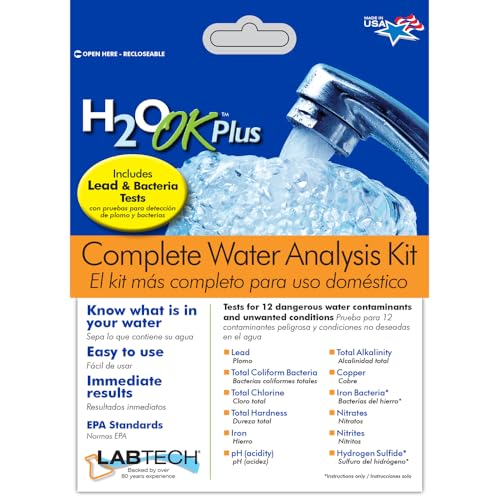
This kit is a strong choice for testers who want a broad, structured water analysis. It includes multiple tests for essential water quality parameters and specifically notes the inclusion of a pesticide test. The kit is described as easy to use with illustrated English and Spanish instructions and backed by research. It is especially suitable for households testing multiple water sources (well water, city water, etc.) and for users who value clear, guided procedures. A potential limitation is that the data relies on proper sample handling; misreading instructions can skew results.
- Best for: households needing a comprehensive panel plus a pesticide check
- Better for: readers who prefer bilingual instructions
- Avoid this if: you require professional-level laboratory verification for every result
Varify 17in1 Drinking Water Test Kit

Best for well, city, or private water supplies where a broad parameter sweep is desired. Varify’s kit covers 17 important water parameters, including lead, chlorine, fluoride, iron, and bacteria. The color-coded strips help users interpret results quickly, making it suitable for families or DIY enthusiasts who want an at-a-glance assessment. A caveat is that strip-based readings can be influenced by lighting and timing; users should follow the color chart precisely and re-test if results are borderline.
- Best for: quick, broad checks across multiple contaminants
- Better for: users who want an easy, visual interpretation
- Avoid this if: you need extremely precise concentration measurements across many parameters
All-New 20 in 1 Drinking Water Kit

This kit focuses on broad testing for home use with 20 different tests and a clear results guide. It is positioned for users who want an efficient, multi-parameter evaluation of drinking water from various sources. The included guide provides straightforward interpretation of results. A limitation is that the kit’s parameter list might not explicitly specify every pesticide or industrial pollutant; verify that pesticides of interest are within the tested range before purchase.
- Best for: households seeking a single-kit solution with many parameters
- Better for: users who value a clear, outside-the-package results guide
- Avoid this if: you must test for a specific pesticide beyond the listed 20 parameters
21-in-1 Home Drinking Water Test Kit

This kit is designed for broad home testing with 21 parameters, including bacteria checks. It’s marketed toward families wanting comprehensive coverage, with additional emphasis on ease of use and clear results. The presence of two bacteria tests adds redundancy, which can help verify results. A potential limitation is that very detailed, lab-grade precision is not guaranteed; use these results as a preliminary screen and consider lab confirmation for critical concerns.
- Best for: households needing extensive screening across many parameters
- Better for: those who want built-in bacteria testing
- Avoid this if: you require professional-grade pesticide quantification beyond at-home strips
Buying Guide: How to Choose a Water Pesticide Test Kit
When selecting a water pesticide test kit, consider what you want to test, how quickly you need results, and how you will use the data. The following questions can guide your decision.
- Do you need a quick screen versus precise quantification? Some kits offer results in minutes, while others require lab confirmation for exact concentrations.
- Which pesticides or related contaminants are most relevant to your water source (glyphosate, arsenic, or other organophosphates)?
- Is ease of use a priority? Color-coded strips and bilingual instructions can help non-professionals read results accurately.
- Do you require tested samples to be compatible with EPA-certified lab services for exact concentrations?
- Will you test multiple water sources (well, city water, ponds) or mainly drinking water?
Practical Tips for At-Home Pesticide Testing
- Read all instructions before starting; timing and environmental conditions can affect results.
- Store test kits as directed; exposure to heat, light, or moisture can degrade test strips.
- Keep separate records for each sample and date to track changes over time.
- Consider periodic testing if you use well water or rely on local groundwater, especially after agricultural activities nearby.
Frequently Asked Questions
- What is a pesticide test kit best used for at home? It’s ideal for quick screening of pesticide residues, such as glyphosate, in drinking water and other freshwater sources.
- Can I rely on at-home tests for exact pesticide concentrations? For precise measurements, use at-home test results as a screening tool and confirm with an EPA-certified laboratory.
- Do these kits test for all pesticides? Test panels vary; some kits include glyphosate, while others test a broad range of water quality parameters. Check the included list before buying.
- Are there kits that also test for bacteria? Yes, several options include bacteria testing along with chemical parameters, useful for comprehensive water safety checks.
- How often should I test my drinking water? For well water or areas with agricultural activity, test at least annually or after significant weather events, pipeline work, or land-use changes.
- What should I do if a test shows a contaminant above acceptable levels? Avoid consuming the water and seek guidance from local water authorities or consider professional remediation.