If you’re looking to extend your swimming season with solar-powered warmth, you’re in the right place. This guide highlights five solar heating options that suit inground pools, along with practical buying tips. Whether you want a simple solar blanket approach or modular inflatables to boost heat, there’s a solution for every pool size and climate. The list favors products that balance heat retention, ease of use, and cost-effectiveness, helping you choose what works best for your backyard oasis.
The buyer profiles below help you match products to needs: casual weekend swimmers may prefer quick-setup solar blankets, while year-round pool owners might opt for longer-term heat retention and modular heating solutions. If you have a large rectangle pool, some covers offer trimable options for irregular shapes. For those concerned with evaporation and chemical savings, many of these products function as both heat absorbers and water-retention aids.
Quick comparison at a glance
- Best overall for full-season warmth: In The Swim 12 Mil and 12 Mil + premium blue rectangle covers—robust heat retention and solar warming for above-ground and inground pools.
- Best for large, irregular shapes: VEVOR 32 x 16 ft solar cover with easy trim-to-fit capability.
- Best modular heating pack: GoFloats V2 inflatable heaters (12-pack or 3-pack) to cover substantial surface area with flexible placement.
- Best for ambiance and temperature monitoring: LightHacker with built-in LCD thermometer while providing pool lighting.
- Best budget setup for small or medium pools: Solar Sun Rings 60-inch rings offer simple, low-cost heat and evaporation control.
| Product | Best For | Key Benefit |
|---|---|---|
| In The Swim 12 Mil Rectangle | Above Ground & Inground | Durable heat retention and active solar warming |
| VEVOR 32 x 16 ft Cover | Large or irregular pools | Excellent heat retention with trim capability |
| GoFloats Inflatable Heaters | Modular coverage | Flexible, scalable heating surface |
| LightHacker Pool Light | Ambiance plus temp monitoring | Integrated thermometer and lighting |
| Solar Sun Rings 60-Inch | Budget-conscious setups | Simple heat and evaporation control |
In The Swim 16′ x 32′ Premium Blue Rectangle Solar Pool Cover

Best for mid-sized pools that need reliable daytime warmth and overnight heat retention. This 12 Mil cover is designed to absorb solar energy and reduce heat loss after sunset, helping extend the swimming season without increasing energy costs. The thicker polyethylene construction supports long-term outdoor use and improves tear resistance.
Who it’s best for: Pool owners with above-ground or inground setups who want a robust, long-lasting cover that balances heat retention with evaporation control. Choose this if you want straightforward installation and predictable, season-long performance.
Limitations include potential reduced effectiveness in highly chlorinated or acidic environments. For irregular pools, precise trimming may be needed to maximize surface coverage and heating efficiency.
VEVOR Solar Pool Cover, 32 x 16 ft
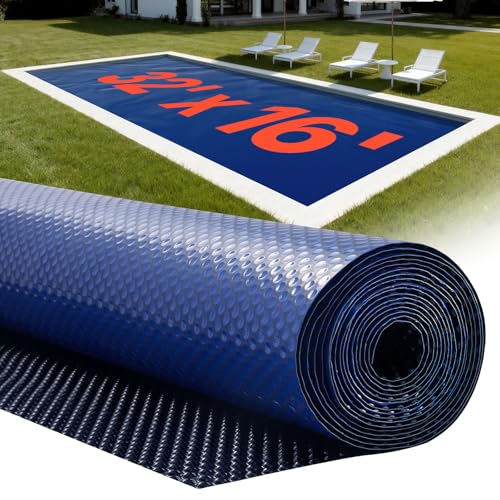
Best for large or irregular pools that require flexible sizing. This 32 x 16 ft rectangle cover uses 16 mil bubble design and a dual heat retention approach with micro-temperature locking bubbles. It stores more heat and slows heat loss, keeping your pool warmer through the day and night.
Who it’s best for: Homeowners with larger or oddly shaped pools seeking a high-capacity heat retention solution that’s easy to trim. Choose this if you prioritize energy savings and extended swim opportunities.
Note: Avoid harsh chemical environments to lengthen the life of the cover. Proper trimming around fixtures ensures optimal coverage and performance.
In The Swim 18′ x 36′ Premium Blue Rectangle Solar Pool Cover
Best for larger inground or above-ground pools needing a balance of heat and evaporation reduction. This 12 Mil cover emphasizes both solar warming and heat retention, helping you extend seasonal swimming without extra energy costs. Durability is enhanced by wide seams that resist tearing and support long seasonal use.
Who it’s best for: Pool owners seeking a strong mix of heat retention and simple handling across a bigger surface area. Consider this if you want a dependable all-season cover with sturdy construction.
Caution: This product is designed for standard pool dimensions; irregular shape compatibility may require trimming or alternative sizing for best results.
Solar Sun Rings 60-Inch UV Resistant Solar Pool Heater

Best for budget-conscious buyers who want a portable, modular heating approach. The two-layer UV-resistant vinyl rings act as a floating, lightweight solar blanket that can be expanded by linking multiple rings. It helps heat the pool during the day and retains heat at night, while also reducing evaporation.
Who it’s best for: Small to medium pools or temporary setups where you want flexible coverage with easy installation. Choose this if you prefer modular heating that’s simple to store when not in use.
Limitation: The effectiveness scales with coverage area; larger pools may require multiple rings to achieve noticeable warmth, and gaps between rings can reduce uniform heating.
GoFloats V2 Inflatable Solar Pool Heaters

Best for modular heating with an emphasis on affordability and easy setup. The V2 design inflates quickly and lays flat, creating a heated surface that collects sun energy by day and provides insulation at night. A good option for covering larger portions of the pool when used in multiples.
Who it’s best for: Pool owners who want scalable heating that can be configured to fit their pool’s shape and size. Choose this if you prefer a simple, inflatable heating system that integrates with other heating sources.
Limitation: Performance relies on surface area coverage; for very large pools, you may need several units to reach noticeable warming effects.
Buying Guide: Solar Heating For Inground Pools
What should you consider when selecting a solar heating method for an inground pool? Here are practical factors to guide your decision.
- Pool size and shape: Larger or irregular pools benefit from bigger, trim-able covers or multiple modular heaters. For standard shapes, a single large cover can suffice.
- Heat retention vs. quick warming: Solar blankets and solid covers emphasize heat retention and evaporation control, while inflatables add surface area for daytime warming.
- Durability and climate: Look for UV-resistant materials and thick polyethylene or reinforced layers for outdoor exposure and longevity.
- Ease of use and storage: Inflatable heaters are easy to store and deploy; rigid or heavy covers may require more effort but offer steadfast heat retention.
- Chemical compatibility: Some covers perform best in mild chemical environments; avoid materials that degrade with high chlorine or acidic water.
- Safety and maintenance: Ensure covers and heaters do not impede pool maintenance equipment and are installed to prevent tripping hazards or debris buildup.
- Budget and scalability: Modular options let you scale heating with changing seasons and budgets, while single large covers provide a straightforward, long-term solution.
Frequently Asked Questions
- What’s the easiest way to extend my pool season with solar heating? A solar pool cover or a set of inflatable heaters can be deployed quickly to trap solar heat and reduce nightly heat loss.
- Do solar covers really reduce evaporation? Yes. They act as a barrier that minimizes water loss from evaporation, helping conserve chemicals and water.
- Can I use multiple heating products together? Yes. Combining a solar blanket with modular inflatables can increase total heat absorption and coverage, especially for larger pools.
- Are these solutions energy-efficient? Most options reduce energy use by cutting the need for electric or gas heaters, though effectiveness depends on pool size, climate, and sun exposure.
- How do I choose between a large solid cover and modular heaters? If you want simplicity and broad heat retention for a standard pool, a large cover is ideal. If you need flexible coverage for varied pool shapes or seasonal adjustments, go modular.
- What maintenance is required? Regularly remove debris, ensure seals are intact, and trim covers as needed to maintain even heating. Avoid environments that aggressively corrode pool materials.