Finding the right self-drive lawn mower can transform yard maintenance from a chore into a quick, predictable routine. This guide highlights five top picks that balance power, maneuverability, and smart features for American lawns. Along with each product section, you’ll see practical notes on who it’s best for and how it performs in typical tasks like mowing slopes, mulching, and edge work. The table below provides a quick snapshot of the featured models for easy comparison.
| Product | Brand | Key Benefit |
|---|---|---|
| YARDMAX 22 in. 201cc | YARDMAX Store | 6-speed CVT for precise pace matching |
| Husqvarna Automower 115H 4G | Husqvarna Store | Ultra-quiet robotic mowing with smart control |
| PowerSmart 21″ 3-in-1 Push | PowerSmart Store | Lightweight 3-in-1 versatility |
| PowerSmart Self Propelled 21″ | PowerSmart Store | Rear-wheel drive for hills and large yards |
| V100 Robot Lawn Mower | YARDCARE Store | Intelligent navigation with obstacle detection |
YARDMAX 22-Inch Self-Propelled Mower

The YARDMAX model features a 201cc engine and an exclusive CVT (Continuously Variable Transmission) that provides six speed options. This enables precise pacing to match walking speed, improving comfort during longer mowing sessions. Aggressive, spiked-tread tires offer enhanced traction on uneven or slick surfaces, improving maneuverability across varied yard layouts. An automatic choke system simplifies starting by eliminating manual priming, which can be a time-saver for users who mow frequently. This mower is well-suited for medium to larger suburban lawns where engine power and traction matter.
Husqvarna Automower 115H 4G

This robotic mower is designed for quiet operation and smart scheduling. It integrates with smartphone controls to set mowing times, adjust preferences, and start or stop remotely. The 0.4-acre suitability makes it ideal for small to mid-sized yards. A reliable wired boundary solution helps the mower navigate complex layouts with shade, trees, and obstacles, ensuring consistent coverage. While it requires initial setup, it offers ongoing maintenance-free operation compared to push mowers, appealing to those seeking automation and minimal manual effort.
PowerSmart 21-Inch 3-in-1 Push Lawn Mower

This lightweight mower uses a robust 144cc OHV engine to deliver reliable performance. The 3-in-1 cutting system supports mulching and side discharge, enabling tailored lawn care whether you want to enrich soil with clippings or dispose of grass efficiently. At about 62 pounds, it remains highly portable for small yards or tight spaces, with a straightforward assembly process. Its compact design makes it a practical option for users seeking an affordable, versatile push mower with decent power and cut quality.
PowerSmart Self Propelled 21-Inch
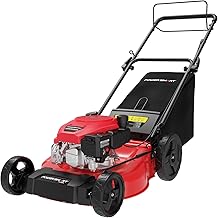
This 21-inch, rear-wheel-drive mower is built for efficiency and ease of use on inclines and larger residential lots. The single-speed self-propel system helps maintain a steady pace, reducing user fatigue during extended mowing sessions. Its 170cc four-stroke OHV engine provides reliable power for mid-size yards, with a steel deck and durable blade designed to deliver clean cuts and manageable clippings. It targets homeowners who want a straightforward, dependable self-propelled option without the complexity of higher-end models.
V100 Robot Lawn Mower

The V100 offers intelligent navigation with AI-driven obstacle detection and a visual bumper sensor. It can identify up to 150 obstacles, and its magnetic no-go strip creates zones to protect delicate areas like flower beds or pools. A compact 4Ah battery supports daytime mowing, and the design emphasizes time-saving operation without the need for complex boundary wiring. This model suits small lawns up to about 1,600 square feet, where automated mowing and zone control provide a clear efficiency edge over traditional mowers.
Buying Guide: Key Purchase Considerations
When choosing a self-drive lawn mower, consider the following factors to match a model to your yard and routine:
- Yard size and terrain: Robotic mowers excel in small to mid-sized, obstacle-filled spaces, while gas-powered self-propelled mowers handle larger lawns and uneven ground with more power.
- Powertrain and propulsion: CVT-based systems offer smooth speed variation for walking pace, whereas traditional single- or multi-speed drives may require manual adjustment. For hills, rear-wheel drive often provides better traction.
- Cutting options: Mulching, bagging, and side-discharge capabilities influence clippings management and soil health. 3-in-1 systems add versatility for different lawn conditions.
- Maintenance and reliability: Gas engines require routine servicing (oil, air filters, spark plugs), while robotic mowers demand firmware updates and occasional boundary adjustments. Look for durable decks and blades for longevity.
- Noise and scheduling: Robotic mowers are notably quiet and can run unattended on scheduling programs, improving convenience for homes with kids or pets. Gas and push models generate more audible noise but offer instant cut readiness.
- Smart features and connectivity: Smartphone control, app-based scheduling, and boundary/wire configurations can save time but may add setup complexity. Wired boundary systems are robust in shaded or cluttered yards, while magnetic no-go zones provide quick, wire-free area protection.
Buying Guide: Comparative Perspectives
- Automation vs. hands-on control: Robotic models prioritize convenience and low ongoing effort, while traditional self-propelled mowers demand active operation but deliver immediate results and flexibility in all weather conditions.
- Maintenance burden: Push and gas mowers require regular maintenance; robotic mowers minimize daily effort but need periodic firmware updates and occasional battery care. Decide based on preferred maintenance routine.
- Cost of ownership: Initial price varies widely. Consider long-term expenses such as fuel, parts, and charging batteries versus the time savings of automated mowing. For small yards, robots may offer attractive value; for large, complex landscapes, a high-powered self-propelled model can be more practical.
- Environmental impact: Robotic and electric-focused options tend to reduce emissions and noise compared to gas-powered units. For quiet neighborhoods or early-morning mowing, this can be a decisive factor.
- Edge and boundary management: If your yard has extensive landscaping, a wired boundary or magnetic zone system can simplify navigation. For minimalist layouts, magnetic zones and ready-to-use robotic units may suffice.