Answering buyers seeking reliable red and blue LED grow lights for indoor plants: these options are suited for seed starting, vegetative growth, and flowering stages. The top picks below emphasize full spectrum blends, timer features, and adjustable intensity to fit different plant types and room setups. Ideal buyers include hobby gardeners, apartment growers, and small tent setups who want energy-efficient lighting that supports year-round growth.
| Product | Brand | Best For | Spectral Focus |
|---|---|---|---|
| LEOTER Grow Light | LEOTER | All stages, with bloom emphasis | Red, Blue, Full Spectrum |
| Hytekgro LED Grow Light (2 Pack) | Hytekgro | Compact, multi-plant setups | Full Spectrum (Red, Blue, White) |
| Garpsen Grow Lights (2 Heads) | Garpsen | Longer timer cycles, seedling to flowering | Red, Blue, Warm White |
| Uallhome 2 Pack LED Grow Light Panel | Uallhome | 4×4 ft tent coverage, year-round growth | Full Spectrum with White/Blue/Red |
| Barrina LED Grow Light (4ft T8, 6-Pack) | Barrina | Large installations, shelf/tan layout | Full Spectrum |
LEOTER Grow Light for Indoor Plants
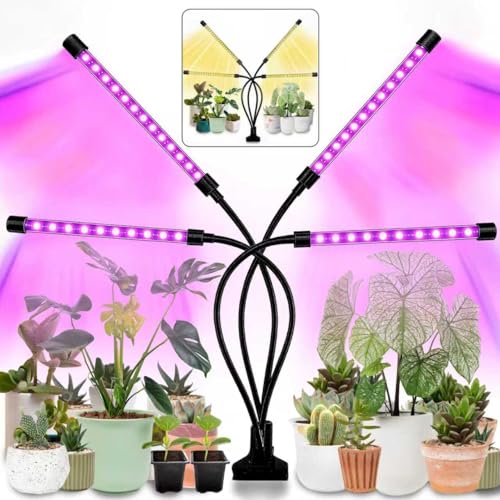
What it is best for: gardeners needing a versatile single-lamp solution with multiple timing and dimming options for all growth stages, including fruiting and blooming.
Why selected: This model combines a robust 80-LED configuration (red, blue, yellow, white) with full-spectrum coverage (380-800 nm) and a memory timer set for 3H, 9H, or 12H cycles. Ten dimmable levels and three spectral modes help tailor light to seedling, vegetative, and flowering needs. The adjustable gooseneck makes it ideal for desks, shelves, or small grow spaces.
Important caveat: The timer needs a reset if power is interrupted, so plan for power reliability if you rely on automatic operation during travel.
Hytekgro LED Grow Light 225 LEDs
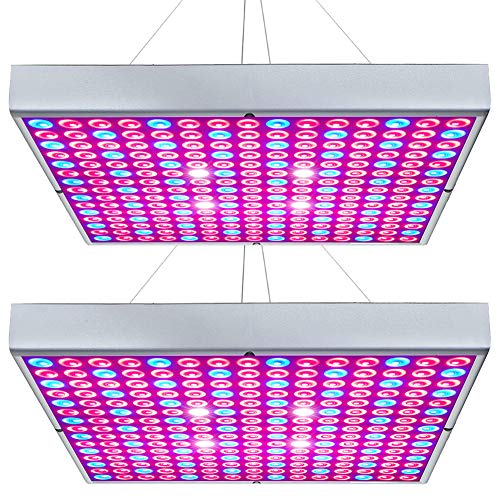
What it is best for: growers seeking a compact yet high-output panel suitable for seedling trays or small grow shelves.
Why selected: The 225-LED array includes abundant red and blue chips with white LEDs for balanced growth. The design emphasizes easy setup with sturdy hanging brackets and a long 59-inch power cord, which helps cover a 3×3 ft area in a typical setup while keeping heat low.
Important caveat: For seedling stages, keep the fixture at an appropriate distance (typically several inches) to avoid light stress; always follow spacing guidelines per plant type.
Garpsen Grow Lights for Indoor Plants

What it is best for: households needing flexible lighting with extended timer options and multi-mode lighting.
Why selected: Two-head design with 9 red and 4 blue plus 7 warm white LEDs per tube delivers richer color mixing. Upgraded 6H/12H/16H timers and three lighting modes (Red/Blue, Warm White, Mixed) accommodate seedlings through flowering, while 5 brightness levels provide customization.
Important caveat: The larger timer extension can be less ideal for crops that require strict photoperiods if mismanaged; ensure the timer aligns with plant stage schedules.
Uallhome 2 Pack LED Grow Light Panel

What it is best for: dedicated four-by-four foot tent environments and greenhouse setups needing broad coverage with a full spectrum.
Why selected: A 200W class panel aimed at indoor gardens seeking year-round productivity. It emphasizes full-spectrum delivery, including UV/IR elements, and includes a six-foot power cord for flexible mounting. Easy suspension makes it suitable for ceiling or wall placements in grow tents.
Important caveat: The panel design favors larger grow areas; for very small setups, a single panel may suffice, and extra panels can easily be added if needed.
Barrina LED Grow Light, 252W

What it is best for: larger indoor gardening spaces or multi-tent setups needing high-efficiency, long-lasting lighting under a single arrangement.
Why selected: The 4ft T8 Barrina units, with 252W total across six lamps, provide a full spectrum and a reflector design to maximize beam reach. The new compatibility and safer connectors streamline daisy-chain linking for bigger projects.
Important caveat: As a higher-output option, ensuring adequate ventilation reduces heat buildup in closed spaces.
Buying Guide
What to consider when choosing red-blue LED grow lights for indoor plants:
- Spectral needs: Combine red-dominant wavelengths for flowering with blue for vegetative growth. Full-spectrum options cover all stages.
- Coverage area: Match light footprint to your grow space. Larger tents may require multiple panels or longer bars; smaller desks benefit from compact lamps with adjustable angles.
- Timer and dimming: Auto ON/OFF functionality saves time and reduces stress on plants. Dimmable outputs help tailor intensity to plant type and growth stage.
- Mounting and installation: Look for adjustable goosenecks, hanging brackets, or clip-on designs that fit your setup without crowding plants.
- Heat and energy: LED systems run cooler and use less energy. Check for heat dissipation features and quiet operation, especially in small rooms.
- Expandability: If you anticipate growth, choose products that readily pair with additional units or panels.
Frequently Asked Questions
- Q: Are red-blue LED lights enough for plant growth, or do I need full-spectrum lights? A: Red-blue LEDs support photosynthesis but full-spectrum lights often provide better growth across all stages and improve color balance in photos.
- Q: How far should grow lights be from plants? A: Distance depends on light intensity and plant type; seedling stages generally require greater distance, while mature plants may tolerate closer placement. Follow product-specific guidelines.
- Q: Do these lights require special adapters? A: Some models use standard USB or included power cords; check the connector type and compatible voltages for your setup.
- Q: Can I daisy-chain multiple lights? A: Many units offer chainable connections for larger installations; follow manufacturer instructions for safe daisy-chaining.
- Q: How do I reset timers after a power outage? A: Timers typically require reinitialization after power loss; refer to the product manual for steps.
- Q: Are these lights suitable for hydroponic systems? A: Yes, most red-blue LED grow lights are compatible with hydroponic setups, provided the space and heat are properly managed.