Choosing the right pressure regulator is essential for reliable drip irrigation performance. This guide reviews five top-rated regulators that help maintain consistent output, protect components, and conserve water across residential and commercial setups. Each option is suitable for low-flow applications like drip lines, soaker hoses, and solid-set systems.
Summary of featured products:
| Product | Brand | Preset PSI | Appropriate For | Notes |
|---|---|---|---|---|
| Senninger Pressure Regulator 25 PSI | Senninger Irrigation Inc. | 25 | Low-flow drip, soaker hose, landscape | High-quality landscape-grade regulator; 0.5–7 GPM |
| Rain Bird HT07525PSI | Rain Bird | 25 | Drip lines and emitters | 3/4″ hose thread connections |
| 2pcs Garden Hose Pressure Regulator 25 PSI | Breezliy | 25 | Drip irrigation systems | 2-pack; ABS construction |
| Rain Bird PRF07530S Drip In-Line 30 PSI | Rain Bird | 30 | Drip systems with inline filtration | Y-filter plus regulator |
| Heavy Duty 25 psi Water Regulator | Vibrant Yard Company | 25 | Residential/commercial drip setups | Lead-free brass; 0.25% lead max |
Senninger Pressure Regulator 25 PSI
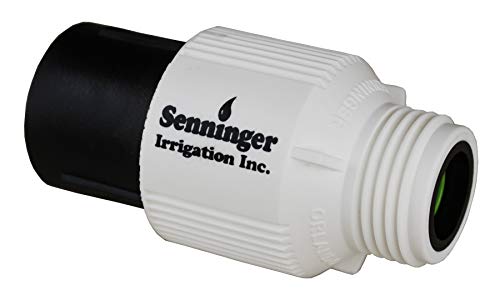
The Senninger PRLG maintains a constant outlet pressure of 25 PSI within a flow range of 0.5 to 7 GPM, making it suitable for low-flow drip irrigation, micro-sprinkler lines, and landscape installations. It is designed for reliability and accuracy with 100% water testing during production, ensuring consistent performance across varying water supplies. The regulator is compatible with standard 3/4″ outdoor faucets and hose connections, helping to preserve distribution uniformity, reduce waste, and extend system life. Its low-flow design supports efficient water and energy use across residential or commercial irrigation projects.
Rain Bird HT07525PSI Drip Regulator

Rain Bird’s HT07525PSI regulator maintains an optimum 25 psi for drip lines and emitter devices and connects to any 3/4″ male pipe threaded faucet, garden hose, or compatible component. With a generous 20 gallons per minute flow capacity, it supports typical drip irrigation layouts while preserving downstream pressure stability. This model is widely used in both residential and light commercial installations, where consistent pressure helps prevent emitter wear and improves uniform water distribution.
2pcs Garden Hose Pressure Regulator 25 PSI (Breezliy)

This Breezliy 2-pack provides 25 PSI preset regulators with 3/4″ female hose thread, designed to fit standard hose connections. The unit offers a pressure compensation range of 30–100 PSI and is constructed from durable ABS material. Inlet and outlet sizing align with common hose bibs and drip components, making it a flexible choice for expanding drip irrigation or retrofitting older systems. The compact design suits home gardens, nursery beds, and light commercial installations where reliable low-pressure operation is essential.
Rain Bird PRF07530S Drip In-Line 30 PSI

The Rain Bird PRF07530S combines a 30 psi in-line regulator with a Y-filter, reducing components and simplifying installation. Its 3/4″ male pipe thread connection makes it easy to integrate into existing drip manifolds or risers. The built-in filtration helps reduce clogging risk downstream, offering a dependable, streamlined solution for maintaining consistent pressure and cleaner water delivery to emitters.
Heavy Duty 25 psi Regulator (Vibrant Yard)

Constructed from solid lead-free brass, this regulator maintains a stable pressure in the 20–30 psi range with an nominal 25 psi setting. It supports flow up to 6.8 GPM and uses 3/4″ hose thread connections, compatible with standard hose bibs and garden hoses. The brass body emphasizes durability and reliability for demanding drip irrigation installations, including garden beds and small commercial landscapes. It can be used with timers, backflow preventers, or filters as part of a broader irrigation system.
Buying Guide: Key Considerations For Pressure Regulators
- Pressure target and range: Match the regulator’s preset PSI to your irrigation layout. Drip systems often perform best around 25–30 PSI, while some setups may benefit from 30 PSI regulators.
- Flow compatibility: Check the regulator’s gallons per minute (GPM) range to ensure it supports the maximum flow your lines and emitters will require without over-pressurizing downstream devices.
- Connection size and type: Most residential drip systems use 3/4″ hose thread fittings or 3/4″ MHT/FHT connections. Confirm outlet and inlet sizes align with your components.
- Materials and durability: Brass regulators tend to offer greater durability and life in outdoor conditions, while ABS units are lighter and cost-effective. Lead content is a consideration for potable systems.
- Integrated features: In-line regulators with built-in filters or Y-filters reduce component counts and simplify installation, while separate backflow preventers may be needed by code in some regions.
- Noise and pulsation: Some regulators may introduce minor pulsation; for precision irrigation where uniformity matters, pick models noted for smooth, steady output.
- Maintenance and filtration: Regularly inspect filters and emitters to prevent clogging and maintain consistent pressure across zones.
- Compatibility with automation: Decide if you want to connect regulators to timers or smart controllers; some units are easier to integrate with automated setups.
In summary, choosing the right pressure regulator involves balancing preset pressure, flow capacity, and compatibility with your existing irrigation hardware. The options reviewed here cover a range of common drip configurations, from compact residential kits to more durable brass models designed for frequent outdoor use. When selecting, consider your water source, preferred maintenance level, and whether an integrated filtration option better suits your installation.