Dealing with Japanese beetle larvae, or grubs, can be challenging for American homeowners who want a healthy lawn without harsh chemicals. This article highlights effective, consumer-friendly options that target grubs at the source or reduce beetle activity. Below you’ll find five products chosen for their relevance to grub and larval control, along with practical usage considerations and a buying guide to help you compare methods.
Summary of selected products
| Product | Brand | Key Focus | Format | Amazon Link |
|---|---|---|---|---|
| St. Gabriel Organics Milky Spore Granular | St. Gabriel Laboratories | Season-long grub control | Granular | View |
| Pro Grub Control – 32oz | Liquid Harvest | Imidacloprid-based grub protection | Liquid concentrate | View |
| Grub Busters Beneficial Nematodes | The Environmental Factor | Biological grub control | Liquid nematode mix | View |
| Organic Insecticide for Roses & Flowers | ARBER | Broad-spectrum insect control including beetles | Ready-to-spray | View |
| Spectracide Bag-A-Bug Japanese Beetle Trap – 2 Count | Spectracide | Adult beetle trapping | Bag traps (2) | View |
St. Gabriel Milky Spore Granular For Grub Control

Milky Spore Granular is designed to target grub populations by delivering a natural bacterium that infects and reduces scarab larvae in lawns. It’s positioned for season-long effectiveness, operating in various weather conditions. The product is described as organic and non-toxic, appealing to households with food-producing areas or children and pets nearby. Application is straightforward, with spreader or manual distribution, and the product begins working upon contact with grubs, potentially lowering future adult beetle emergence without repeated treatments in many cases.
Pro Grub Control – Imidacloprid Insecticide

Pro Grub Control provides a more immediate chemical option for grub suppression, featuring 21.4% Imidacloprid. This product is designed for application on turf, as a foliar spray, or to the soil, supporting a broad range of landscape ornamentals beyond lawns. While effective, it is a synthetic systemic insecticide; consider rotation and environmental considerations if targeting Japanese beetle larvae specifically, as well as label directions regarding timing and scenario-specific use around edible crops.
Grub Busters Beneficial Nematodes

The Environmental Factor Grub Busters use beneficial nematodes to naturally target white grubs and related larvae, including Japanese beetle larvae. This biological approach avoids chemical residues and is compatible with organic and sustainable lawn care. Easy hose-end application makes it practical for large lawns, though sprayer compatibility and availability of a sprayer are considerations. Nematodes are temperature-sensitive, so timing in late spring to early summer is often ideal for effective results.
Organic Insecticide for Roses & Flowers

ARBER’s Organic Insecticide for Roses & Flowers offers a ready-to-spray solution designed to control a range of pests including aphids, thrips, Japanese beetles, and more. It attaches to a standard garden hose for even coverage, eliminating mixing or bulky equipment. This product supports plant health by reducing active infestations and helping protect blooms. While labeled for outdoor use and a broad pest array, it is not limited to larvae control; it covers adult beetles and other pests, providing a broader plant defense strategy.
Spectracide Bag-A-Bug Japanese Beetle Trap – 2 Count
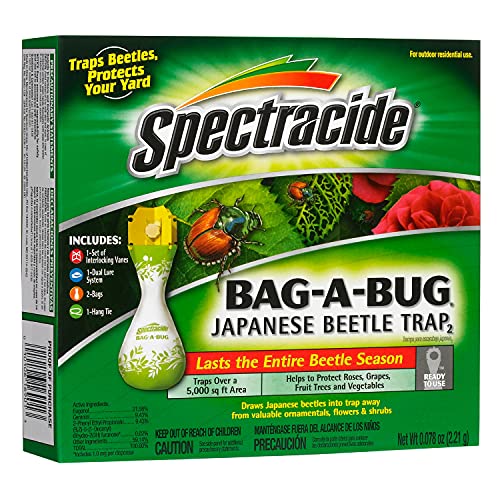
These traps are designed to capture adult Japanese beetles, reducing beetle pressure on ornamental plants, fruit trees, and garden crops. The dual-lure system combines a sex attractant with a floral lure, which can attract higher beetle numbers than a single lure. While these traps address the adult beetle stage rather than larvae, they complement larval control strategies by lowering overall beetle populations and slowing reinfestation cycles.
Buying Guide: Key Considerations for Japanese Beetle Larvae Control
- Target life stage: If your primary issue is grubs, products with bacteria-based or nematode biology (Milky Spore, Grub Busters) offer larval control with fewer synthetic inputs. For immediate knockdown, consider targeted insecticides, but monitor for resistance and use according to label.
- Mode of action: Biological controls (nematodes) work best within specific temperature windows; chemical controls (imidacloprid) work quickly but require careful timing and risk assessment for beneficial insects and pollinators.
- Application method and convenience: Granular spreaders, hose-end sprays, and hose-linked nematode applications each have advantages. Consider lawn size, accessibility, and whether you prefer DIY methods or pre-mixed solutions.
- Safety and environmental impact: Organic and non-toxic options are preferable for homes with children, pets, or edible gardens. If using chemical insecticides, follow label directions and consider integrated pest management (IPM) strategies to minimize non-target effects.
- Long-term strategy: A combination approach—biological controls to suppress grub populations over time, plus traps to manage adults—often yields the best balance of effectiveness and sustainability.
- Regulatory and regional considerations: Some products are more suitable for certain regions and lawn types. Always verify label details for your climate and turf.
In summary, a layered approach that includes both grub-targeting solutions and adult beetle management tends to provide the most comprehensive control. The Milky Spore Granular and Grub Busters nematodes offer organic, long-term options, while the imidacloprid-based product provides a rapid response when grub pressure is high. Complementary tools like organic insecticides for ornamentals and traps can help reduce beetle populations and protect garden beds.