Answering the needs of homeowners seeking precise, two-zone irrigation, these dual outlet water timers help manage separate areas with customized schedules. The best options suit different garden sizes, weather conditions, and data needs. This guide highlights five top picks that reliably control two independent outlets, with clear reasons for who should choose each. Ideal buyers include dedicated backyard planters, small to medium lawns, greenhouses, and hands-off gardeners who travel frequently. A quick comparison table follows to help you decide at a glance.
Quick product snapshot
| Product | Best For | Why Pick It |
|---|---|---|
| Orbit 58910 | Beginner to intermediate users | Simple setup, reliable dual-outlet control |
| Insoma 2-Zone | Large yards with pressure needs | All-brass inlet, robust programming and two zones |
| RAINPOINT 2 Zone Sprinkler Timer | Smart water-saving users | Clear scheduling, robust rain delay |
| BN-LINK Sprinkler Timer Outdoor | Detailed two-zone control | Independent zones, strong rain-delay features |
| Diivoo 2 Zone | Durability-focused setups | Leak-resistant brass, large display |
Orbit 58910 2-Outlet Programmable Digital Hose Watering Timer

The Orbit 58910 converts a standard hose faucet into a programmable watering system with two outlets. It features an easy-to-read LCD screen and simple programming to set start time, duration, and frequency. The device retains your programs even after battery changes, which is useful for long-term setups. Best for beginners or users who want straightforward daily irrigation without complex zoning. A potential limitation is that it may rely on battery power; plan for battery replacement to maintain schedules on multi-week trips.
Insoma 2-Zone Hose Timer – Brass Inlet Dual Outlet

Insoma offers a 2-zone independent watering timer with a durable brass inlet and dual outlets. Its dual-zone programming supports separate start times, frequencies, and durations for each zone, allowing tailored watering across different garden areas. The unit can monitor real-time operations via an LED screen, and it withstands higher pressures up to 116 psi. Manual mode and a robust metal filter gasket help prevent sediment ingress. Best for larger yards or greenhouse setups needing precise zoning. A limitation is the device’s more advanced programming, which might require a learning curve for new users.
RAINPOINT 2 Zone Sprinkler Timer – Brass Inlet

RAINPOINT’s 2 Zone Sprinkler Timer emphasizes flexible scheduling for two zones with a brass inlet and a practical rain delay feature. Programmability covers start times, durations, and frequencies up to seven days, with rain delay options of 24, 48, or 72 hours. This makes it a solid choice for gardeners who want to protect plants from overwatering after unexpected rain. The timer supports both automation and manual watering for emergency needs. If you require more than two zones or highly granular control, you may prefer a different model.
BN-LINK Sprinkler Timer Outdoor – 2 Zone
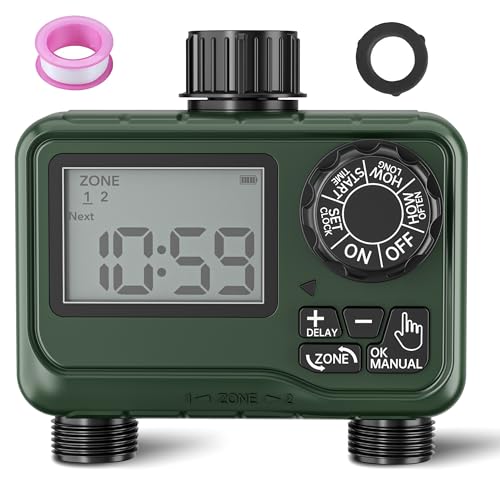
BN-LINK delivers a dual-zone timer with independent programming for each outlet. It supports 12/24-hour formats and offers auto-run with durations from 1 minute to 12 hours, plus frequencies from every 1 to 12 hours or 1 to 7 days. The built-in rain delay can pause irrigation for 24, 48, or 72 hours, preserving moisture during inclement weather. This model suits users who want clear, precise, and flexible scheduling on a reasonable budget. A caveat is its IP54 rating, which is adequate for outdoors but not fully submersible in heavy storms.
Diivoo Brass Sprinkler Timer 2 Zone
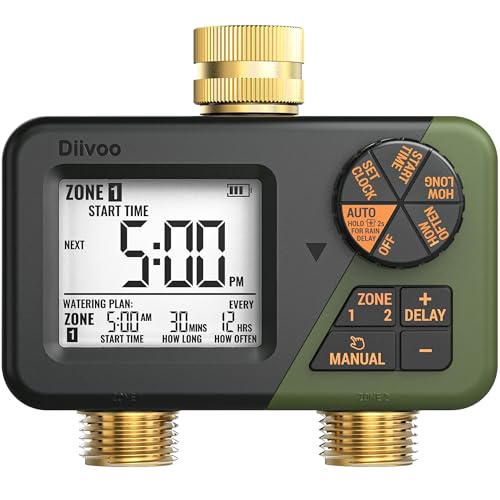
Diivoo emphasizes durability with leak-resistant brass inlets and outlets, rated for 7.25-116 PSI, plus a large display that shows current time, active zone, and next watering schedule. The timer supports two zones with independent start times, durations (0–240 minutes), and frequencies (every 1/3/6/12 hours or 1–7 days). The brass construction and metal filter kit help resist wear and sediment intrusion. Best for users needing a hardy, long-lasting outdoor timer. A limitation is that the feature set may be more than needed for small, simple gardens.
Buying Guide
What to consider when choosing a dual outlet water timer
- Zone independence: If your garden has markedly different irrigation needs, a timer with truly independent zones (two separate schedules) offers the most flexibility.
- Inlet/outlet material: Brass constructions tend to resist corrosion and withstand higher pressure, but plastic options can be adequate for light use in mild climates.
- Programming complexity: Simple LCD-based timers are quick to set up; advanced models may require more time but deliver finer control over start times, frequencies, and durations.
- Watering duration and frequency range: Look for timers that support both short-duration (1 minute) and long-duration (several hours) watering, plus frequent or weekly intervals as needed.
- Rain delay and weather safeguards: An effective rain-delay feature helps conserve water after rain and protects plants from overwatering.
- Durability and weather resistance: IP ratings, construction quality, and a robust sealant kit are important for outdoor use in varied climates.
- Manual override: A reliable manual mode can be valuable for spot-watering or adjusting schedules on the fly without reprogramming.
How to install and set up a dual outlet timer
- Attach the timer to a faucet with a compatible thread size.
- Insert fresh batteries if required and ensure the current time is set correctly.
- Program the two zones with distinct start times, durations, and frequencies as needed.
- Enable rain delay if your climate experiences frequent rain; test both zones for leaks.
- Position the timer in a shaded or sheltered spot to extend battery life and readability.
Replacement and maintenance tips
- Replace batteries regularly to prevent program loss in Orbit-style models.
- Inspect brass connections for corrosion and replace gaskets if signs of wear appear.
- Clean the screens to prevent sediment buildup, especially in hard water areas.
What to expect in terms of performance
Dual outlet water timers provide reliable, scheduled irrigation with minimal user intervention. They help prevent underwatering and overwatering by enabling zone-specific schedules. For best results, match your timer to your garden layout, water pressure, and climate. If a timer feels too feature-rich for your needs, a simpler two-zone model may offer the right balance of control and ease of use.
Frequently asked questions
- Q: Do dual outlet timers work with high water pressure?
A: Most models are designed to handle typical home water pressure, but some brass-inlet units tolerate higher pressures and resist leakage better than plastic-inlet counterparts. - Q: Can I operate both zones on different schedules?
A: Yes. The primary benefit of a dual-outlet timer is independent control of each zone’s start time, duration, and frequency. - Q: Is there a model with a battery backup?
A: Some models retain settings when power or battery changes occur, but many rely on fresh batteries to keep the clock running. Check the product specifics for backup behavior. - Q: How accurate are rain delay features?
A: Rain delay options typically pause irrigation for 24, 48, or 72 hours to prevent water waste after rainfall. - Q: Are these timers easy for beginners?
A: Many units feature large LCD displays and step-by-step programming, making them approachable for first-time users. Simpler models are often fastest to set up.