Choosing the right drip line for trees helps deliver efficient, uniform watering while reducing waste. This guide reviews top 5 drip irrigation products, highlighting emitter spacing, length, compatibility, and durability. Whether you’re setting up a new tree grove or enhancing a landscape, these options offer practical, water-efficient solutions for American gardens.
| Product | Brand | Length | Emitter Spacing | Best For |
|---|---|---|---|---|
| (100′ ft Roll) 1/4-Inch Dripline | One Stop Outdoor | 100 ft | 6 inches | General landscape and trees |
| ML-506B ¼” MICROLINE Dripline | DIG | 500 ft | 6 inches | Large garden areas, long runs |
| DIG ML-106 100′ Dripline | DIG | 100 ft | 6 inches | Compact setups, universal fitting |
| SH512 ¼” MICROLINE Dripline | DIG | 500 ft | 12 inches | Raised beds and wider spacing |
| Habitech 100 Ft Roll Dripline | Habitech | 100 ft | 6 inches | Simple, all-in-one tubing |
Note: All products reviewed support 1/4-inch fittings and are designed for easy integration with standard irrigation hardware. The table above is for quick comparison; read each section for detailed specs, installation considerations, and garden-use recommendations.
(100′ ft Roll) 1/4-Inch Dripline with 6-Inch Emitter Spacing
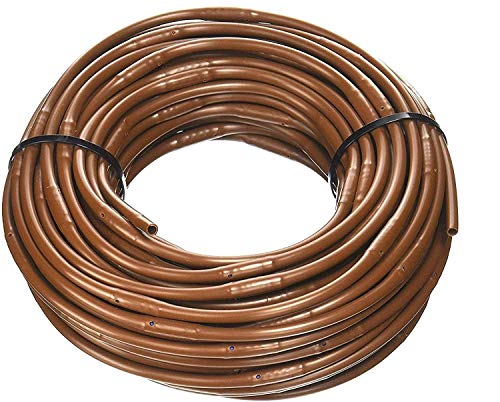
This 100-foot brown roll is designed to work with 1/4-inch fittings and features 6-inch emitter spacing, delivering 1/2 GPH per emitter. The tubing is formulated to resist common landscaping chemicals and fertilizers, helping maintain performance over time. It is flexible for easier routing around roots and trunks, and is compatible with most 1/4-inch barbed fittings. Suitable for tree lines, shrubs, and mixed landscapes that require targeted, low-volume irrigation at the root zone.
ML-506B ¼” MICROLINE Dripline, 6” Emitter Spacing

Designed for extensive irrigation needs, the ML-506B offers a 500-foot length with 6-inch emitter spacing and emitters delivering approximately 0.52–0.65 GPH at 15–25 PSI. This setup supports uniform root-zone watering for large areas with a consistent feed. Note that the recommended single-run length from a 1/2-inch supply is about 16 feet to maintain uniformity; longer runs may reduce flow consistency toward the distant emitters. It is compatible with standard 1/4-inch fittings for flexible expansion.
DIG ML-106 Dripline, 100′ 6” Spacing
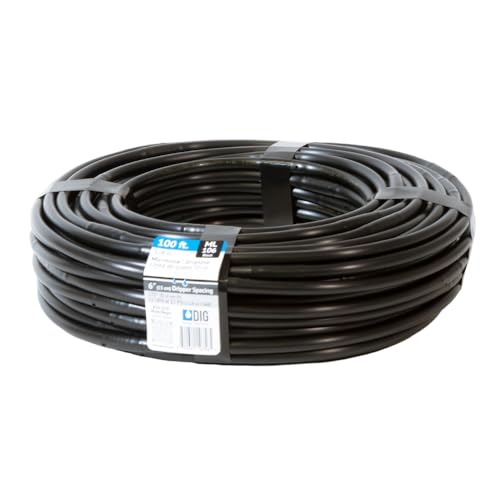
This 100-foot MICROLINE dripline features 6-inch emitter spacing and emitters rated at 0.52–0.65 GPH within a 15–25 PSI range. It emphasizes uniform root-zone watering and supports simple installation with universal 1/4-inch barb fittings. The product notes recommend limiting run lengths to preserve even water distribution; longer lines require careful planning or stage pumping to minimize pressure loss and uneven emitter flow.
DIG SH512 ¼” MICROLINE Dripline, 12” Spacing

The SH512 variant provides 12-inch spacing with 0.52–0.65 GPH emitters at 10–25 PSI, ideal for raised beds and larger garden layouts where wider spacing improves coverage. Like other MICROLINE lines, the maximum recommended length from a 1/2-inch supply is about 28 feet to maintain uniform distribution. The tubing supports compatibility with 1/4-inch fittings and can be used with multiple brands to fit diverse irrigation designs.
Bonviee 200ft 1/4 Inch Drip Irrigation Tubing

Bonviee’s 200-foot drip irrigation tubing emphasizes flexibility and durability, allowing tight turns with fewer elbows during installation. The tubing is designed to withstand various weather conditions and can be buried or laid on the surface, making it suitable as a main line or to branch off from a larger 1/2-inch drip system. This option is user-friendly for homeowners seeking straightforward setup for tree lines and lawn borders.
MIXC 1/4″ Dripline Tubing, 100 Ft Roll
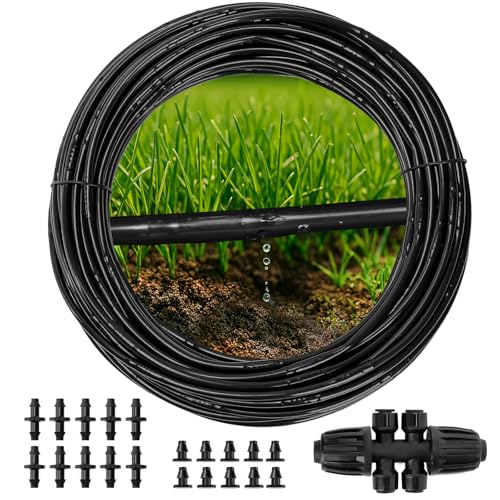
The MIXC 100-foot tubing comes with built-in emitters at 6-inch spacing, delivering 0.5 GPH per emitter and offering the convenience of not needing separate drippers. The tubing is UV-resistant and designed for reuse across seasons, suitable for raised beds, vegetables, flowers, and greenhouses. Its built-in emitters provide a streamlined setup for homeowners seeking quick deployment and reliable root-zone watering.
DIG ML-112 100′ Dripline, 12” Spacing
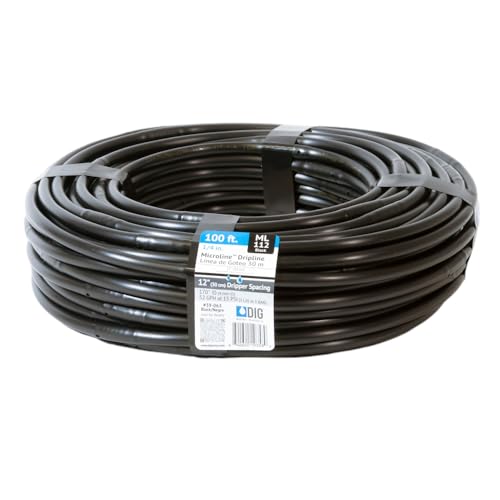
The ML-112 features 12-inch spacing with emitters of 0.52–0.65 GPH within a 15–25 PSI range. It emphasizes uniform watering across longer rows and warns that longer runs reduce uniformity toward the far end from the supply. Compatibility with 1/4-inch barb fittings ensures flexible integration into existing irrigation setups. This option is suitable for landscapes requiring wider emitter spacing and deeper root-zone reach.
Buying Guide
Key purchase considerations for drip lines:
- Emitter spacing: Choose spacing based on plant types and row width. 6-inch spacing suits dense plantings; 12-inch spacing fits longer rows and wider beds.
- Length and run planning: Longer runs can cause pressure loss and uneven watering. Plan the supply loop and consider booster stages for large installations.
- Water flow and PSI: Emitters vary by GPH. Verify your water pressure and select tubing that maintains consistent flow across the run.
- Fitting compatibility: Most brands use 1/4-inch barb fittings. Ensure compatibility if expanding with other brands.
- Durability and environment: UV resistance, chemical tolerance, and weather resilience affect longevity in outdoor settings.
- Installation simplicity: Built-in emitter tubing reduces complexity for beginner setups; modular lines offer flexibility for complex layouts.
- Reuse and maintenance: Durable lines can be buried or surface-installed and reused across seasons; keep an eye on potential clogs and flush points.
When selecting a drip line for trees, prioritize uniform root-zone coverage, ease of installation, and long-term durability. For large landscapes, consider longer runs with appropriate supply lines and potential pressure management to maintain uniform emitter flow. For smaller or irregularly shaped spaces, flexible tubing with built-in emitters reduces fittings and simplifies routing. Evaluating these factors helps ensure efficient water use and healthy tree growth across diverse American gardens.