Best 3 point seed planters help you plant seeds accurately with tractor power, giving consistent row spacing and depth. These options suit farmers with medium to large plots, hobby growers upgrading from hand seeding, and anyone needing reliable 3-point hitch integration. Below, five top choices are analyzed for best use cases, with practical guidance to help you pick the right model for your crops and field conditions. A quick buyer’s table is provided for fast comparison.
Summary table of selected products
| Product | Best For | Key Benefit | Notes |
|---|---|---|---|
| Field Tuff 3-Point Corn and Bean Planter | Medium to large fieldcorn/beans | Ground driven with adjustable row width | Hopper capacity and seed control require setup |
| Agri-Fab 45-0640 3lb Push Seeder | Small to medium plots, diverse seeds | Versatile seed plates for up to 20 types | Push design – lighter use than full 3-point |
| John Deere 3lb Garden Seeder | Prepared soil, row spacing accuracy | Wide rear wheel for soil contact | Rust-resistant plow blade for reliable rows |
| Labasuan 3-Point Tractor Planter | High-density to wide-row crops | 9 spacing options, fast attachment | 3-point hitch versatility; longer setup time possible |
| Chapin 8701B Garden Push Seeder | Small gardens or trial plots | 6 seed plates, 1.5 L hopper | Not a true 3-point hitch; best for smaller tasks |
Use this guide to compare how each model handles row spacing, seed types, depth control, and mounting effort. The six questions below help you decide quickly: Do you need ground-driven seed meters or a manual push system? How many seeds and how many plate options are essential for your crop mix? What soil conditions and crop residue require robust furrow openers? How important is ease of attachment to your tractor’s 3-point hitch?
Field Tuff 3-Point Corn and Bean Planter

Best for medium to large plots that require adjustable row width. This planter is ground driven and designed to plant corn and beans with a 14- to 36.6-inch row width range, allowing you to tailor spacing to crop variety and field layout. An adjustable seed opening helps control emergence depth, while 13-inch pneumatic tires support stable traction and depth consistency. Each hopper holds up to 15 pounds or .22 bushels of seed, making it suitable for longer planting runs without frequent refilling. Although robust, it benefits from careful setup to match soil conditions and row spacing. The planter is clearly aimed at users who want durable field equipment with reliable seed control and adjustable row width.
Best for: Farmers needing adjustable spacing for corn and beans, with a field-driven system.
Limitations: Slightly larger footprint requires space and proper transport on the tractor; ensure seed type compatibility with the adjustable seed control.
Agri-Fab 45-0640 3lb Push Garden Seeder

This model is best for gardeners needing high seed variety compatibility in smaller to medium plots. The poly hopper holds up to 3 lb, and it includes seven interchangeable seed plates to accommodate up to 20 seed types. The aluminum frame provides rust resistance, which helps with longevity in varied weather. It’s a push-style planter rather than a tractor-mounted 3-point unit, so it’s best for hand-guided or light tractor use. Choose this if you value broad seed compatibility and a lighter, easier-to-maneuver setup.
Best for: Small to medium plots with a diverse seed mix and a preference for a lighter, push-style planter.
Limitations: Not a true 3-point hitch device; may be less suitable for heavy-duty field operations or large acreages.
John Deere 3lb Garden Seeder
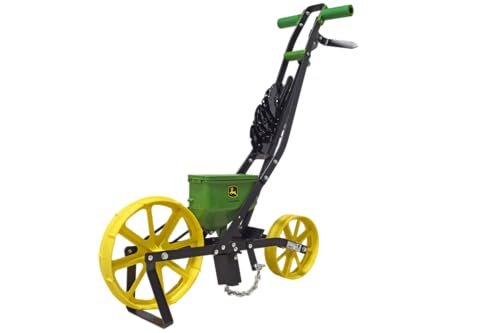
This seed planter is well suited for prepared soil and precise row spacing. It features a wide rear wheel to help ensure good seed-to-soil contact, and a rust-resistant plow blade that preps the row effectively. An adjustable row marker helps ensure correct spacing, which is essential for uniform germination and productivity. It’s a solid choice for gardeners and small farms aiming for repeatable rows with straightforward setup.
Best for: Users prioritizing accurate row marking and stable soil preparation in prepared beds.
Limitations: Limited seed plate variety compared to some multi-plate units; designed primarily for steady, single-season planting tasks.
Labasuan 3-Point Tractor Planter

This 3-point planter is positioned for versatility across crops with eight seed plates and adjustable row spacing and depth control. The stainless steel furrow opener enables on-the-fly depth changes, and the seed distribution can be scaled by removing or blocking nozzles. It’s designed for efficiency in large farms with the ability to gang multiple units for high-density planting. Mounting is straightforward, and many users appreciate the depth and spacing control it provides for both high-density grains and wide-row crops.
Best for: Farms needing flexible spacing options and robust field deployment, including potential for multi-unit setups.
Limitations: Setup time may be longer due to multiple parts and spacing configurations; ensure compatible tractor hitch and frame capacity.
Chapin 8701B Garden Push Seeder

The Chapin 8701B is tailored for small gardens and trial plots with six seed plates supporting up to 20 seed varieties. It uses a 1.5-liter hopper made of rust-resistant material and a durable powder-coated steel frame. The operator simply marks the row, plows, plants, and covers as they walk. This unit is ideal for gardeners who want a compact, reliable tool that can handle a range of vegetables and small-scale crops. It’s a practical choice when portability and a straightforward workflow matter most.
Best for: Small gardens or plots, where ease of use and variety are critical in a single compact tool.
Limitations: Push design means more manual labor over large acres; not a tractor-mounted solution.
Chapin 8701G Garden Push Seeder

This Chapin model is similar to the 8701B but emphasizes multiple seed types with six interchangeable plates for up to 20 vegetable varieties. The 1.5-liter hopper provides a compact, rust-resistant option for gardeners who prefer a push-style tool with reliable seed distribution and row marking features. It suits those who want a simple, manual setup with good versatility for different crops on small to medium plots.
Best for: Gardeners needing a versatile, multi-plant push seeder with solid durability for diverse crops.
Limitations: Not a 3-point hitch unit; best for smaller garden projects rather than large-scale fieldwork.
Buying Guide
What to consider when choosing a 3-point seed planter:
- Confirm your tractor’s 3-point hitch class and weight capacity. Some units mount directly, while others are push-style or require adapters.
- If you grow a diverse crop mix, prioritize models with multiple seed plates and adjustable seed openings for precise spacing and depth.
- Look for adjustable row widths and furrow depth control to handle different crops and soil conditions.
- For longer planting runs, consider hopper size to minimize refills. Balance capacity with the unit’s weight and balance on slopes.
- Rust-resistant frames, stainless steel openers, and robust wheels contribute to longer service life in varied weather.
- Evaluate how easy it is to attach, adjust, and operate, especially for seasonal workers or smaller operations.
Frequently Asked Questions
- What is a 3-point seed planter? It is a seed planting implement that attaches to a tractor’s 3-point hitch, allowing hands-free seed placement with adjustable row spacing and depth.
- Are 3-point planters suitable for small gardens? Many are designed for larger plots, but some models like Chapin push planters work well for small gardens or trials.
- Do these planters support multiple seed types? Some models offer multiple seed plates and adjustable openings to accommodate different seeds.
- Is depth control important? Yes, consistent depth improves germination and yields; choose a model with reliable depth adjustment.
- Can I gang multiple units? Certain heavy-duty models are designed to be linked for large-scale operations, but verify compatibility and stability with your tractor.
- What maintenance is required? Regularly inspect furrow openers, seed plates, and hoses; keep moving parts lubricated and clean to avoid seed jams.