 Trusted Garden Reviews
A useful rose fertilizer supplies something the plant needs, in a form you can apply correctly. The word organic, a picture of a large flower, and a high middle number on the bag cannot establish that need. Begin with the growing conditions: sunlight, root space, moisture, soil test results, and the nutrients already supplied by compost or potting mix. Then choose a fertilizer that fits those conditions.
Four options below are granular rose or flower feeds; Great Big Roses & Flowers is a liquid compost-extract supplement alternative, with a different role. They should not be compared as interchangeable ways to deliver the same amount of nitrogen. This research-based guide uses product labels, manufacturer information, and horticultural guidance. We have not performed a comparative growing trial.
Start with the decision, not the biggest nutrient number
For an established bed that needs a general rose feed, compare the granular options against the soil report and the label on the actual bag. Espoma Rose-tone offers a clearly documented rose-specific feeding routine. Down To Earth Rose & Flower Mix has a higher phosphate percentage, which matters when phosphorus is needed but offers no automatic advantage where the soil already has enough. Jobe's and Dr. Earth also belong to the rose-and-flower granular category; confirm the formulation and application directions of the package you receive.
For a container rose, begin with the container instructions. A rate intended for a shrub in open soil is not a safe shortcut for a pot. If the potting mix already contains fertilizer, record its feeding period before adding another feed. If your immediate problem is waterlogging, heavy shade, or damaged roots, a different fertilizer is unlikely to solve it.
| Existing option | Role in a feeding plan | Useful reason to consider it | Check before choosing |
|---|---|---|---|
| Jobe's Organics Rose & Flower Granular | Granular rose and flower feed | A measured application around established plants | Actual bag analysis; current manufacturer information differs from older packaging |
| Espoma Rose-tone | Granular rose-specific feed | Manufacturer directions distinguish plants, beds, and containers | Match the rate to the planting situation and existing feeding |
| Down To Earth Rose & Flower Mix | Granular 4-8-4 feed | A documented higher-phosphate formulation | Whether the soil report supports additional phosphorus |
| Dr. Earth Total Advantage | Granular rose and flower feed | A separate granular option for planted beds or suitable containers | Do not confuse the dry fertilizer with the liquid or planting-mix products |
| Great Big Roses & Flowers | Liquid compost-extract supplement alternative | An optional addition with a different nutrient analysis | It is not a complete substitute for a measured base fertilizer |
Jobe's Organics Rose & Flower Granular
 Check Price on Amazon
Jobe's rose-and-flower granules suit gardeners who prefer to measure a dry feed and apply it around the root area. The important specification is the analysis on the bag, rather than the product-family name alone. The manufacturer's current rose-and-flower page lists 3-5-3, while older packaging can show 3-4-3. Treat that difference as a reason to read the delivered label, not to transfer an old dose to a changed formulation. Jobe's product information.
This is a practical candidate when the soil report supports a complete feed and you can spread it evenly. For a row of roses, measure each plant's application rather than scattering an estimated handful along the whole border. Uneven distribution can produce very different exposure among plants, especially where the bed narrows near a wall or a path.
Best fit: established roses in a manageable bed, with an application routine based on the actual instructions. Less suitable: a container for which you cannot find matching directions, a bed with excessive phosphorus, or a situation where an unmeasured application is likely. Organic ingredients do not make unlimited application acceptable. Keep the bag stored securely and follow its handling and watering directions.
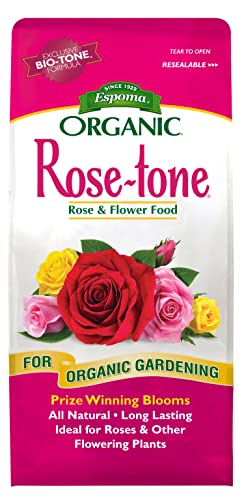
Espoma Organic Rose-tone
 Check Price on Amazon
Rose-tone is a granular 4-3-2 feed. Espoma publishes different directions for individual plants, rose beds, and potted plants, making it easier to build a routine around the actual planting arrangement. Those separate directions are more useful than treating every rose as one standard-size shrub. Espoma Rose-tone and the manufacturer fact sheet provide the formulation and application context.
The main reason to shortlist it is a clearly documented feeding process. A gardener caring for several established roses can record the amount, application date, watering, and response in a simple notebook. The value comes from making the feeding reproducible. It does not mean that a calendar reminder should override a soil report, a drought-stressed plant, or fertilizer already present in a new container mix.
Best fit: gardeners who want a rose-specific granular feed and will distinguish container and bed rates. Check carefully: the start and end of the growing season in your own climate. A monthly growing-season label is not a universal instruction to feed every month of the year. Microbe-related manufacturer descriptions also do not establish that your particular soil lacks useful organisms or that the product will correct drainage.
Down To Earth Rose & Flower Mix
 Check Price on Amazon
Down To Earth's Rose & Flower Mix has a 4-8-4 guaranteed analysis. The manufacturer also identifies its ingredients and supplies separate directions for roses, beds, transplants, and containers. Its higher available-phosphate percentage is a specific difference from the other granular feeds here. Manufacturer formulation and directions.
That difference matters only in relation to the soil and application rate. If a soil report recommends no additional phosphorus, a rose photograph on the package does not make an 8-percent phosphate feed the better match. If phosphorus is recommended, the product becomes a candidate, but you still need to check the nitrogen and potassium delivered at the chosen rate.
Best fit: a feeding plan that has a documented reason to include the product's nutrient balance. Less suitable: repeatedly feeding a high-phosphorus bed because more flowers are desired. It is also inappropriate to transfer a per-plant open-ground rate directly into a small pot. This is a measured nutrient input, not a general cure for every flowering problem. Choose it for its analysis and usable directions, not because the middle number is the largest in the comparison.
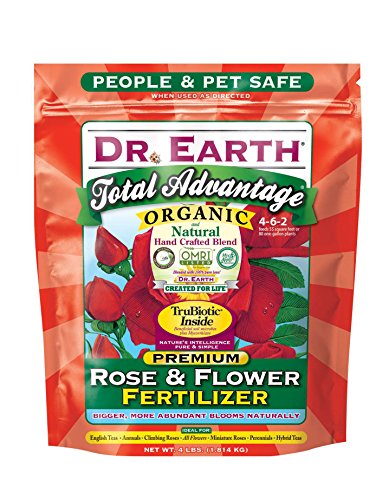
Dr. Earth Total Advantage Rose & Flower Fertilizer
 Check Price on Amazon
This option is the dry rose-and-flower fertilizer. Dr. Earth also uses Total Advantage branding for liquid feed and planting mix, which have different purposes and instructions. Its catalog identifies the dry rose-and-flower formulation as 4-6-2. Compare the actual dry-fertilizer bag, not a bottle or bag of planting mix with a similar name. Dr. Earth product catalog.
This distinction becomes important when comparing reviews or application directions found elsewhere. A liquid pump instruction is not a direction for granules, and a planting mix's volume is not a fertilizer dose. Confirm the product form, bag size, nutrient analysis, and appropriate use before making it part of the plan.
Best fit: a gardener who prefers this granular formulation and has checked that its nutrient contribution matches the bed or container. Do not assume: that natural ingredients make the material edible for pets, harmless in any quantity, or necessary for every flowering plant. Handle the product according to its label and keep animals away from stored material and freshly treated areas as directed.
Great Big Roses & Flowers: a supplement alternative
 Check Price on Amazon
Great Big Roses & Flowers is presented by its manufacturer as a liquid compost extract used alongside a fertilizer program. Its listed analysis, 0.04-0-0.4, is very different from the granular feeds in this guide. It should therefore be considered a supplement alternative, not ranked as an equivalent complete rose fertilizer. Manufacturer product information.
The practical question is what the supplement would add to an already understood feeding plan. If the garden has a diagnosed nutrient shortage, compare the nutrient amount delivered rather than expecting a small-analysis supplement to supply the same input as a granular feed. If the problem is heavy shade, standing water, or root damage, neither a supplement nor a stronger fertilizer removes the underlying cause.
Consider it when: you want to evaluate an optional soil-related supplement, understand its separate role, and can follow its dilution instructions. Leave it out when: the base feeding plan is unclear or you are likely to stack several products without recording their combined inputs. Do not turn manufacturer benefit claims into a promise of a particular number of blooms. A measured trial area with otherwise consistent care is more informative than applying several new products everywhere at once.
Buying guide: establish what the rose actually needs
1. Check light, roots, and moisture before nutrients
A rose can grow poorly because its roots cannot function well, even when nutrients are available. Look at the site through the day, inspect the moisture below the surface, and note whether nearby plants show similar symptoms. A shaded border, a pot standing in a water-filled saucer, or a planting hole that holds water needs a growing-condition response first.
Make the observation concrete. If one plant beside a downspout struggles while plants farther away are healthy, record the pattern before selecting a feed. If every rose in a newly shaded bed has fewer flowers, changing the whole feeding program may distract from the light problem. University of Maryland Extension lists several causes of poor flowering and recommends using soil-test evidence when fertilizing. Rose problem identification.
2. Use a soil report for a bed, not a guess from leaf color
Leaf color is a clue, not a complete nutrient diagnosis. Water stress, root injury, diseases, and unsuitable pH can also affect appearance. For an in-ground bed, use a laboratory soil test with recommendations for the planting type. Follow the laboratory's sampling instructions and keep a visibly different problem area separate when instructed.
Record the report date and units. A recommendation expressed per area needs the bed's area, while a label expressed per plant requires an appropriate plant count and size. Do not compare a concentration number in the soil report directly to a percentage printed on the bag. They describe different things. A report also cannot tell you everything about drainage or root damage, so retain the physical observations alongside the chemistry.
3. Read N-P-K as a delivered amount
In standard US fertilizer labeling, the three numbers give percentages by weight of nitrogen, available phosphate, and soluble potash. They are not a flowering score. For a hypothetical one-pound application of 4-3-2 fertilizer, the amounts are 0.04 pound nitrogen, 0.03 pound available phosphate, and 0.02 pound soluble potash. That arithmetic explains the label; one pound is not an application recommendation.
When comparing two feeds, first decide the permitted rate. A lower-analysis product applied at a larger rate may deliver more of a nutrient than a higher-analysis product used sparingly. The application instructions and soil recommendation have to be considered together. Avoid choosing a product by dividing the three numbers into a simple good-versus-bad ranking.
4. Account for everything already added
Compost, manure-based amendments, starter fertilizer, granular feed, and some potting mixes all contribute nutrients. Write them in the same record. A second product should have an identifiable reason for being added, rather than being selected because the first feeding did not produce an immediate visual change.
A useful record has six fields: plant or bed, product, amount, date, soil moisture, and the planned review date. Add rainfall or watering notes where relevant. This makes it possible to see whether a plant has received repeated applications from more than one person. It also prevents the common mistake of treating a liquid supplement as invisible in the overall care routine.
5. Distinguish containers from open ground
Container roots occupy a limited volume. The mix, drainage holes, existing fertilizer, pot size, and watering routine all matter. Read the container-specific label before applying a granular feed. The diameter of a pot, the volume of mix, and the size of the plant are not interchangeable ways to calculate a rate unless the label makes that relationship explicit.
Before feeding, inspect the drainage path: water should be able to leave the inner pot and any decorative outer pot. Check whether the root ball is actually moist, rather than assuming water passing down the sides has wetted it evenly. Feeding a dry, poorly wetted root ball or a saturated pot complicates diagnosis. Correct the moisture problem and follow the product's directions for application to container plants.
6. Match the routine to climate and active growth
The same rose cultivar can have different growing seasons in different regions. Read local extension guidance alongside the product label, especially for the final seasonal application. A manufacturer's illustrative spring-to-autumn routine should not be copied to every climate without checking the plant's growth and local conditions.
Keep a distinction between maintenance and recovery. A plant recovering from transplanting, severe pruning, prolonged drought, or root trouble may need a different immediate response from an established actively growing rose. If the label or local guidance does not cover the situation clearly, ask a local extension service rather than inventing a stronger dose.
7. Measure, distribute, water, and review
Choose a dedicated measuring tool and mark it for garden use. Follow the actual rate and placement instructions; do not pile granules against the crown or concentrate the whole amount in one small patch. Keep material off paths and other surfaces where it can be washed away.
After applying and watering as directed, give the care plan an appropriate review period. Photograph the same plant from the same position and record new growth, leaf condition, and flowering behavior. A before-and-after picture by itself does not prove that fertilizer caused the change, because weather and normal growth also change. The record still helps avoid impulsive additional feeding while waiting for a response.
Three realistic decisions
An established rose bed with adequate phosphorus: shortlist an option that fits the soil recommendation rather than defaulting to the highest phosphate percentage. If none of the retained feeds matches the report, do not buy one merely to complete a shopping list. Use the report to find the appropriate category locally, or ask the laboratory for interpretation.
A patio rose planted in a pre-fertilized mix: find the mix's existing feeding information, verify drainage, and use a fertilizer with clear container directions when additional feeding is appropriate. Keep a liquid supplement separate in the record. The fact that a pot is watered often does not justify increasing the dose without a label-based reason.
A rose with few blooms and a wet root zone: investigate the wet conditions, light, and plant health before changing fertilizer. A concentrated feed is not a drainage repair. If other plants in the same area also struggle after rainfall, document the location and seek a site-level explanation.
Common questions
Is an organic fertilizer automatically safer to overapply?
No. Organic describes aspects of the formulation or production standard; it does not remove the need for a measured rate, correct storage, and label-directed handling. Excess nutrient input can still be unhelpful. Do not choose an application amount from words such as natural, gentle, or pet friendly.
Will a higher phosphorus number guarantee more flowers?
No. A high available-phosphate percentage is meaningful when additional phosphorus is warranted. It cannot correct shade, waterlogged roots, unsuitable pruning, or another cause of poor flowering. A soil report and site observations provide a better starting point than bloom-booster language.
Can two granular rose feeds be combined?
Do not combine full application rates casually. The nutrients overlap, and the resulting total can exceed the intended input. If a feeding plan calls for more than one material, calculate the contribution of each and follow applicable directions. Changing one input at a time also makes the outcome easier to interpret.
Is Great Big Roses the same as a complete fertilizer?
Its published analysis and intended role differ from the granular feeds here. Treat it as a separate supplement alternative. Do not substitute it one-for-one by volume or assume that a low nutrient analysis will supply an identified major-nutrient shortage.
What should I check when the delivered package differs from a photograph?
Confirm the product name, form, guaranteed analysis, size, and directions before using it. Packaging can change, and a family name can cover several products. If the material received does not match the intended recommendation, pause the application and resolve the difference with the supplier or manufacturer.
Compare the cost of a justified application
A useful price comparison starts with the job. Measure the bed or identify the label's plant-size category, then use that product's directions to calculate the amount needed. Do the same independently for the other product. Different analyses and rates mean that the cheaper price per pound may not be the cheaper treatment.
For a hypothetical example, Product A costs $24 for a 4-pound bag and its relevant directions require 0.5 pounds for a particular measured job. Its material cost for that job is $3. Product B costs $20 for a 4-pound bag but requires 0.75 pounds for the same defined job under its own directions; that application costs $3.75. These invented values illustrate the calculation and are not rates or prices for the products in this article.
Use the appropriate labeled job in both calculations. A new planting, an established rose, and a container do not necessarily use comparable directions. It would be misleading to use a container rate for one product and an established-bed rate for another simply because both produce a smaller number.
Now include practical costs. Can you measure the dose reliably? Do you already own a suitable measure? Is the smallest available package a manageable amount for your garden? Can the product be stored according to its directions? A large bag's apparent value can disappear if most of it is unnecessary or poorly stored.
For liquids, compare useful applications after the correct dilution and application volume, rather than bottle volume alone. A small concentrate and a larger ready-to-use bottle can represent different amounts of work. Read the exact formulation instead of inferring value from packaging size.
Avoid projecting many future applications just to justify a bulk purchase. Future need depends on plant performance, soil information, seasonal growth, and input history. You are buying for a feeding plan, not taking on an obligation to use the whole bag.
Set a useful review point before feeding
Write down what prompted the application. A confirmed recommendation from a soil report, container directions accounting for the existing medium, or a locally appropriate maintenance decision is more precise than “the roses should flower more.”
Choose observations that relate to that reason. Record new growth, relevant symptoms, root-zone moisture, and the flowering stage. Photograph from the same position. Weather and the normal seasonal cycle can change the display even without a different product.
If you also move a pot into more light, change watering, prune, and add compost, be cautious about attributing improvement to fertilizer alone. These changes may all be sensible, but the result is not a controlled product comparison. A home-garden observation should be described as such.
When the response is disappointing, check the measured amount, exact formulation, timing, and original diagnosis before increasing the dose. A supplement used as though it were a complete feed, rich medium receiving overlapping products, and a shaded rose are different problems. The next useful step depends on which occurred.
Keep the original package or a clear photograph of its directions. If an online manufacturer page later changes, you will still know what was applied. That is especially helpful with products whose current analysis differs from older packaging.
A final pre-application check
Keep the task small and verifiable: identify the plant, read the actual label, compare the soil recommendation, account for recent inputs, and measure the permitted amount. A good buying decision leaves you with a clear routine and a reason for the chosen feed. If that reason is still missing, further observation is more useful than adding another product.